Pages

NOKIA

Hands-on: Nokia Lumia 610

SAMSUNG

Samsung Galaxy Chat goes big on texting

WiFiSlax

Hack Wifi : WiFiSlax 4.1 Final (WiFi Hack BootCD)

SAMSUNG

Samsung Galaxy Pocket

Motorola

Motorola Atrix 2

Thursday, June 21, 2012

Microsoft introduces Windows 8 mobile operating system

Untitled-2.jpgSEATTLE: Microsoft Corp's new phone software will be built on the same core as its new upcoming PC and tablet operating system, bringing the company one step closer to unifying its Windows franchise across a full range of screens that are revolutionizing computing.

The world's largest software company, which is running to keep up with Apple Inc's iPhone and Google Inc's

Android devices, said the common core means customers will have a greater choice of phones and applications, and be able to switch between multiple machines more easily.

The move follows the launch of the Surface tablet on Monday, Microsoft's effort to join the fast-growing mobile computing market and to tackle Apple's iPad head on.


 At an event in San Francisco on Wednesday, Microsoft officially announced its new phone software, called Windows Phone 8, and said phones running the software would hit the market this autumn.

The new phones - made by handset makers Nokia, Samsung Electronics, HTC Corp and Huawei on Qualcomm dual-core chips - will feature voice commands, Skype calling, near-field communication (NFC) for wireless transactions and built-in maps for GPS directions.

Microsoft's voice recognition feature goes beyond Apple's rival Siri service by allowing users to issue commands to apps, not just the phone's core operating system.

The new software will support NFC transactions - in which the user taps a reader to make a purchase - but Microsoft is leaving it to independent software makers to write the actual applications controlling the process, meaning it will not be a direct competitor to the Google Wallet service for Android phones.


Microsoft's new phones will have an updated, customizable start screen in Microsoft's new 'Metro' style, which centers on touchable 'tiles', or colorful squares, representing people, applications and services which update in real time, for example showing Facebook posts or new email.

The Metro style is also the interface for Microsoft's Windows 8 operating system - designed to run on both tablets and traditional PCs - which Microsoft is expected to launch around October.

The success of the phones partly depends on the marketing support they get from carriers. No. 1 US mobile operator Verizon Wireless said in April it expects to have Windows Phone 8 devices in time for the holiday shopping season as it wants a strong competitor to Apple's iPhone and Google Inc's Android.

No. 2 US mobile operator AT&T and No. 4 T-Mobile USA said they plan to carry Windows Phone 8 smartphones later this year. No. 3 US operator Sprint declined to comment.

APP DEARTH Microsoft's Windows phones have been well reviewed but have not caught on in the market, partly due to the fact that there are only 100,000 or so apps available, compared to 500,000 or so for both Apple and Android devices.

Microsoft is hoping that a common core between its PC and phone software will make it easier for developers to create applications for both, with minimal adjustments.

The company said current devices, which run on Windows Phone 7.5, will not be able to update to Windows Phone 8. Windows Phone 7.5 users will be offered an update that includes the new software's start screen but excludes other features. That could dampen sales of Windows Phone 7.5 devices for the next few months until the new crop of phones appears in stores.


The Redmond, Washington-based company has invested billions of dollars in phones - including a deal with Nokia to use its software - in an attempt to break into the market.

So far it has had little impact, capturing only 2 per cent of the world's smartphone market last quarter, according to tech research firm Gartner. Google's Android leads the market with 56 percent, followed by Apple with 23 per cent.
 

Wednesday, June 20, 2012

Vodafone joins 3G price war; cuts tariff by 80%

On one hand, telcos are battling the 2G auction diktat, while on the other the 3G war amongst the companies is heating up. Following its contemporaries, Vodafone announced that it has slashed 3G tariffs by up to 80%.
Vodafone’s move makes it the fourth telecom service provider after Bharti Airtel, Idea Celluar and Reliance Communication to reduce rates. 

According to experts, telcos are trying to monetize on 3G investments as it has so far dent profits. Moreover, experts point out that 3G investments have led to higher depreciation and interest payout. 

3G dynamics
Experts:
3G investment has led to higher debt level
3G contribution to revenue under 10% presently
3G subscriber base under 10 mn for leading telcos
Roughly 25% 3G subs are active
Rural penetration still low
Domestic market price sensitive
3G to be main growth driver
 
Key highlights:
New entrants sparked cuts in voice tariffs post 2009
Telcos hiked voice tariffs in July 2011
3G rate cut intended to offset effect of hike in voice tariff

LG launches Optimus 3D MAX and Optimus L7

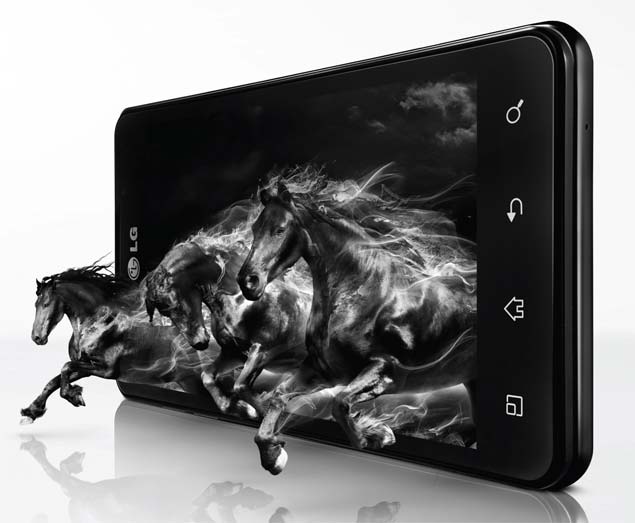
lg-optimus-max3d.jpgLG Electronics has now officially launched two new Optimus devices - the LG Optimus 3D MAX and the Optimus L7 smartphones in India. Both these devices have been available on Flipkart for about a week now.
A successor to the LG Optimus 3D, the LG Optimus 3D MAX sports a 4.3-inch screen with WVGA resolution & NOVA Display. It is powered by a 1.2GHz dual-core processor, 1GB RAM, has 8GB of internal storage and two 5 MP cameras. Priced at Rs. 30,500 (Market Operating Price), the LG Optimus 3D MAX runs on Android 2.3 and has a 1520mAh battery.
Soon Kwon, President South West Asia Region & MD LG India shares, "With the Optimus 3D MAX, we want to set new standards of quality viewing and powerful performance on mobiles packed in a slim and modern design".
The other handset announced is the LG Optimus L7, which has a 4.3-inch display and runs on Android 4.0. LG Optimus L7 also has a 5MP rear camera but its front camera is 1.3 MP. Other features include a 1 GHz processor, 1 GB RAM and onboard storage on 4 GB. The MOP of this smartphone is Rs. 19, 900.
"Design is consistently an important factor for customers when choosing a mobile phone and with L-Style we're going to go back to our roots as a company focused on products that fit into the lifestyle of customers," adds Kwon.
LG Optimus 3D Max P725 key specs:
  • Android 2.3
  • 5 MP camera
  • 0.3 MP front camera
  • 4.3-inch TFT LCD
  • 1.2 GHz dual-core processor
  • Expandable storage capacity up to 32 GB
  • 1520 mAh battery
LG Optimus L7 P705 key specs:
  • Android 4.0
  • 5 MP camera
  • 0.3 MP front camera
  • 4.3-inch LCD
  • 1 GHz processor
  • Expandable storage capacity up to 32 GB
  • 1700 mAh battery

Motorola launches Razr Maxx for Rs. 31,590, Razr V to land in Q3

Motorola has announced two new smartphones for the Indian market today - Motorola Razr Maxx, and Motorola Razr V. NDTV Gadgets had reported about a week ago that Motorola is planning to launch Motorola Razr Maxx and now it is here.
moto.jpg
The most notable feature of Motorola Razr Maxx is the huge 3,300 mAh battery inside, which according to the company gives 17.6 hours of talk-time on a single charge. Motorola Razr Maxx also sports a 4.3-inch Super AMOLED Advanced display and is just 8.99 mm thick. The smartphone runs on Android 2.3 and is expected to get an upgrade to Android 4.0 soon. It comes with a dual-core 1.2 GHz Cortex-A9 processor on board. Priced at Rs. 31,590, the handset will go on sale from June 21, 2012.
On the other hand, Motorola Razr V is the first Ice Cream Sandwich smartphone from the company. It is just 8.35mm thin, and features a dual-core 1.2 GHz processor. It will be available in charcoal, glacier white and rebel pink colour options. There are no details in regards to the pricing of this smartphone as of now and it is expected to be available by Q3, 2012.
Both the new Motorola Razr devices come with a splash-guard coating and Gorilla Glass for enhanced durability.
Motorola Razr Maxx key specs:
  • Android 2.3
  • 8 MP camera, 1080p HD video recording
  • 4.3 inch AMOLED display
  • 1.2 GHz dual-core processor
  • 1024 MB RAM
  • 3300 mAh

Motorola Razr V key specs:
  • 4.3-inch (960 x 540 pixels) capacitive touchscreen
  • Android 4.0 (Ice Cream Sandwich) OS
  • 8MP auto-focus camera with LED Flash, 1080p HD video recording
  • 8.35 mm thick and weighs 125 g
  • 1GB RAM, 32GB expandable memory with microSD

Saturday, June 16, 2012

Acer Launches Aspire S5, World’s Thinnest Ultrabook Costs $1,399


Is it the thinnest Ultrabook? Acer says it is. The company’s new Aspire S5 measures just 0.59 inches at its thickest point and weighs 2.65 pounds. (Overall, it’s 12.8 x 8.95 x 0.44-0.59 inches). This system has a 13.3-inch display with a humdrum resolution of 1366 x 768, but inside, it boasts pretty good specs. A third-generation Intel Core i7-3517U processor, 4GB of RAM, Intel HD Graphics 4000, and a 256GB SSD. The cost is a pretty steep $1,399, but you do get a big solid state drive for your money.
Both the S5 and the S3, which is also being updated, will have two USB 3.0 ports, HDMI, and a headphone/mic jack, but the S5 will also have a Thunderbolt port, and come with an HDMI-to-VGA adapter. How does it cram all this in? By a motorized panel on the bottom of the notebook that opens up at the press of a button. It looks pretty cool in person , but the jury’s still out on its practicality. 
The Aspire S3-391 is essentially a refresh of last year’s model with a new Champagne color and a lower starting price of $648. For that, though, you get a second-generation 1.4-GHz Intel Core i3-2377M processor, 4GB of RAM, Intel HD Graphics 3000, and a 320GB, 5,400-rpm hard drive and a 20GB SSD cache, similar to the first version of the Aspire S3. As before, this notebook measures 12.6 x 8.5 x 0.51-0.68 inches.
The S5 has a 3-cell, 2310 mAh Lithium-Ion battery that it says will last up to 6.5 hours; the S3 has a 3,280 mAh battery that will last up to 5.5 hours.

GALLARY

Leaked Screenshots Show Upcoming Changes To Microsoft Office Products


Microsoft’s been keeping changes to its various Office offerings under decently tight wraps, but details about both the upcoming Office 15 and changes to the online Office apps have still been popping up on the Web. Today’s tasty tidbits: the Chinese site CNbeta.com has leaked screenshots that suggest Office 15 is getting a new name and a new logo, while LiveSide.net managed to snag images of some upcoming UI changes to Microsoft’s Office Web Apps, which are integrated into SkyDrive and Hotmail.
Looking past CNbeta’s watermark above, you’ll see what the site claims is the new Office logo, which fits in nicely with the visual scheme adopted by the redesigned Windows logo that appears in Windows 8. Take a close peek at the name in the top of the window: Microsoft Office Mondo 2014 Preview. That also makes sense, assuming the screenshot proves to be real, as the last three Office iterations worked the year into their titles.
Windows reporter Paul Thurrott has gotten his hands on the Office 15 beta, which is expected to launch in June. He’s posted a bevy of in-action screenshots over on WinSuperSite.com.
LiveSide.net, meanwhile, says that the picture below comes from a preview version of changes to Office Web Apps, and more specifically, the Microsoft Word Office Web App. The images on the left come from the current version, while the images on the right show the tweaks coming down the pipeline, including the ability to see comments in Reading mode and a more Metro-friendly file menu, complete with tab names listed in all caps.

LiveSide.net has a few more pictures up on its website, so check it out if you’re interested. There’s no word on when the new-look Office Web Apps Preview is expected to roll out to everybody.